


The Blessed Doctrinarian Martyrs
Blessed Claudius Bochot and Eustace Felix
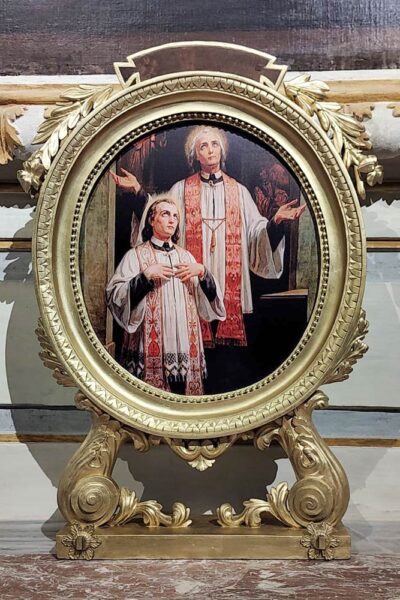
The new painting depicting the blessed, to be placed on one of the side altars of the church of Santa Maria in Monticelli, in Rome, in October 2026.
Before 1789, the Fathers of Christian Doctrine had 64 houses, colleges or seminaries in France, 29 of which were in the province of Avignon alone. The French Revolution marked the end of the presence of the Doctrinaires in France. After several attempts, it was necessary to wait until 1966 to see their stable presence again.
Two Fathers, Claude Bouchot and Eustace Felix, martyrs of September 1792, were beatified by Pope Pius XI in 1926. To their name must be added that of Father Joseph Raoulx, born in Graveson and General Assistant of the Congregation, guillotined in Paris in 1794, whose beatification process is underway. Worthy disciples of Father Cesare, the three doctrinaries, belonging to the same community of Paris, offered their lives in fidelity to Jesus Christ, to the Church and to the Congregation, becoming “living catechisms”.
In 1676 the General House of the Congregation was transferred from Saint-Jean-le-Vieux in Avignon to Saint-Charles Borromeo in Paris. From that date until the French Revolution, this latter House was the center of the Congregation. When the Revolution broke out, the Superior, Father Claudio Bochot, and the bursar, Father Eustachio Felix, managed to save most of the brothers. When the revolutionaries arrived, all those who did not subscribe to the “Civil Constitution of the Clergy” were arrested, deported and killed. This happened to the two fathers who were taken to the Seminary of San Firmino, which in the meantime had been transformed into a prison. The Abbot of Salamon, an eyewitness who miraculously escaped the massacre that occurred on the night of September 1st to 2nd, recounts: “The other prisoners who were already at the Abbey were informed that they had been massacred at the Convent of Carmine. At this news, everyone threw themselves at the feet of the Curé of Saint Jean au Gréve, asking him with great compunction for absolution in articulo mortis. That holy man, after having prayed for a moment in silence, exhorted us to recite the Confiteor and to make an act of faith, contrition and love of God; after which he gave absolution very devoutly. The Curé said to us: “We can consider ourselves as sick people in agony, but while we retain our reason and full knowledge, we must not omit anything that can merit God’s mercy. I will recite the prayers of the dying; join me, so that God may have mercy on us.” He began the Litany, to which we all responded with fervor. The tone in which that worthy Priest pronounced the first prayer, which begins: “Depart, soul, from this world in the name of God the Father Almighty…” moved us; almost all of us wept. Everything was prepared for the horrible massacre; we were approaching the fatal hour. They brought us dinner; it was two o’clock; we heard the roar of the alarm cannon… One of us, restless, agitated, went to a window; he saw soldiers in the courtyard of the palace and asked why the alarm cannon had thundered. “Verdun was taken by the Prussians,” was the reply. This was a lie; Verdun did not fall until a few days later. Everyone knows now that the roar of the alarm cannon was to be the signal for the massacre on that bloody day. The assassins had orders to begin the killing at the third shot.”
The decree for their beatification says that they were killed inside the House, or thrown out of the window onto the street, where there were ferocious women who rushed upon the priests to beat them bloody with sticks; not content with this, they climbed onto the carts where the bodies were placed and trampled them, cut them into pieces and proudly showed the limbs to passers-by shouting “Long live the Nation”.
Very little is known about the lives of these two doctrinaires. Father Claude Bochot was born in Troyer, in Champagne, on July 13, 1720, the son of Eustace and Elizabeth Léger. He entered the Novitiate of the same House of Saint Charles on October 10, 1740 and made his profession on October 16, 1741. In 1759 he was Rector of the College of Noyer and then moved to the House of Saint Charles, where he was elected Rector several times, the last time from 1789 to 1792.
Father Eustace was also born in Troyer, on April 24, 1736. He entered the Novitiate of the Congregation in Paris on May 20, 1757. After having been in various communities, Vitry-le–François, Chaumont–en–Bassigny, he returned to the House of Saint Charles, with the office of Procurator, which he retained until his imprisonment in 1785. He participated in the Provincial Chapters of 1786 and 1789. During the latter he was elected Councilor of the Province. As such, on October 11, 1791, he signed the last resolution taken by the Doctrinaries of Paris. Both fathers are remembered for their exemplary lives spent entirely in the exercise of the sacred ministry for the benefit of their brothers. Humility and charity stood out in them: two qualities that form apostles and enable them to provide spiritual and material help wherever need requires it.
The places where these massacres took place soon became a destination for pilgrimages, where many people went to pray in honor of the sacrificed priests. Fathers Claudio and Eustace were beatified, along with 189 other martyrs of the French Revolution, on October 17, 1926. The liturgical feast was established on September 2.